Your cold email works. The stack underneath it doesn't anymore.
If you're...
- Spending more time fixing the sending stack than running outreach
- Watching your sequencer, mailbox vendor, and warmup tool point fingers when deliverability drops
- Stuck because you can't afford to pause sending while a new system warms up
SuperSend exists to do one thing: get cold email into the inbox at scale. We give you the software and the dedicated sending infrastructure underneath it.
Book your strategy call
Pick a time while the problem is fresh.
Calendar opens on the current month. If this month looks full, use the arrow in the calendar to view next month's open times.
The pain isn't your copy. It's the stack underneath it.
You're not starting from zero. You have an offer, a list, and an outbound motion that already works. What is breaking is the infrastructure underneath it. The cracks show up the same way at 200 mailboxes as they do at 13,000.
The mailbox stack became the job
You're running a small inbox factory: hundreds or thousands of mailboxes, multiple vendors, warmup schedules, senders that drop offline. Cold email stopped being marketing and turned into ops.
Your old platform was never built for cold
Constant Contact, Qualtrics, SendGrid. None of them were designed for cold outreach. They restrict reminders, throttle sends, and quietly stop delivering when they notice what you're doing.
Scaling makes everything more fragile
The business wants more volume yesterday. But every shortcut sets the system further back, not forward: rushed warmup, half-tested migration, more rented mailboxes.
The two playbooks most teams default to. In 2024, both quietly broke.
Before 2024, you could get away with either. After Google rolled out new bulk-sender requirements and Microsoft tightened policy enforcement, both started running into walls they never used to hit.
Bad Option 1
Rent the mailboxes
Buy Google or Outlook mailboxes from a provider like MailScale, HyperTide, or Inframail. Connect them to a sequencer like Instantly or SmartLead. Warm them, rotate them, replace them.
What changed: Google and Microsoft policies now actively push against bulk cold email from their platforms.
Bad Option 2
Force a marketing platform to send cold
Use Constant Contact, Mailchimp, Qualtrics, SendGrid, or another platform built for opt-in marketing or transactional email to do a cold outbound job it was never designed for.
The failure mode: stricter spam filters, policy restrictions, marketing-style headers, and messy reply handling at cold volume.
In writing. Google's Workspace Acceptable Use Policy prohibits using the service to generate, distribute, publish, or facilitate unsolicited mass email. Microsoft's Online Services Acceptable Use Policy prohibits transmitting any unsolicited bulk or commercial email. Both are official, current platform policies.
What works now: a platform built for cold email at scale
SuperSend's job is to get cold email into the inbox at scale. That mission has three jobs.
Land in the inbox.
If the message lands in spam, nothing else matters. Dedicated infrastructure, controlled reputation, isolated sending.
Get read and replied to.
Right cadence, right message, with reply handling that catches every "yes," every "not now," every "talk to this person instead."
Hand off cleanly to your sales motion.
Replies route into your CRM, your AI agents, your Salesforce workflow. The signal lives where the work happens.
The five components underneath those three jobs:
01
Dedicated sending infrastructure
Email servers, dedicated IPs, root domains and subdomains, sender identities, and warmup before production ramps.
02
Cold email sequencing
Campaigns, sequences, sender profiles, A/B testing, and contact routing your team operates day-to-day.
03
Reply operations
Replies classified and routed: interested, meetings, OOO, bounces, and "talk to this person instead."
04
Pacing and allocation
The platform allocates capacity automatically. You do not manually assign mailboxes to campaigns.
05
Enterprise integration surface
CRMs, webhooks, AI agents, Salesforce workflows, suppression lists, and reporting.
What dedicated cold email infrastructure actually looks like
Your volume fans out across managed mail servers and dedicated IPs. SuperSend handles pacing, warmup, placement visibility, and sender health.
What changes when you stop renting the sending layer
Dedicated infrastructure does not make cold email magic. It makes the system controllable. The questions you ask yourself every week change.
Before
“Which vendor broke the mailbox this week?”
After
“What volume are we ready to support?”
Before
“Why are replies showing up 30 minutes late?”
After
“Which replies need to route to sales right now?”
Before
“How many more inboxes do we need to buy?”
After
“What sending capacity do we need this month?”
What happens when teams stop fighting their sending stack
Positive replies / month
A large B2B lender moved off Instantly plus rented mailboxes onto SuperSend's dedicated infrastructure.
Same offer. Same target list. The bottleneck was the sending layer, not the message.
“300 leads in a single day.”
Same sending volume as before. The infrastructure was finally doing what it was supposed to do.
Federal Benefits Contractor
1.3M/moMigrated off Constant Contact after 15 years of declining deliverability. Production live within weeks on dedicated infrastructure.
B2B Lending Firm
2-3M/moMoved off Instantly plus rented mailbox providers. Same sales motion, dedicated infrastructure underneath.
If you are trying to land cold email in the inbox at scale, you are in the right place
We do not have a volume threshold or a tier you need to qualify for. The signal is simpler: are you trying to do this job, and is your current setup making it harder than it should be?
This is for you if
- You want your cold messages to land in the inbox, not the spam or promotions folder.
- Your current sending setup is starting to crack and you are tired of patching it.
- You want one platform that owns sending, deliverability, replies, and your sales integrations.
- You own your offer and your list and you want a better sending layer underneath them.
You're probably better served elsewhere if
- You are sending opt-in newsletters or product transactional email. Those are different jobs.
- You need an agency to source the leads and write the copy for you. This is infrastructure, not outsourced outbound.
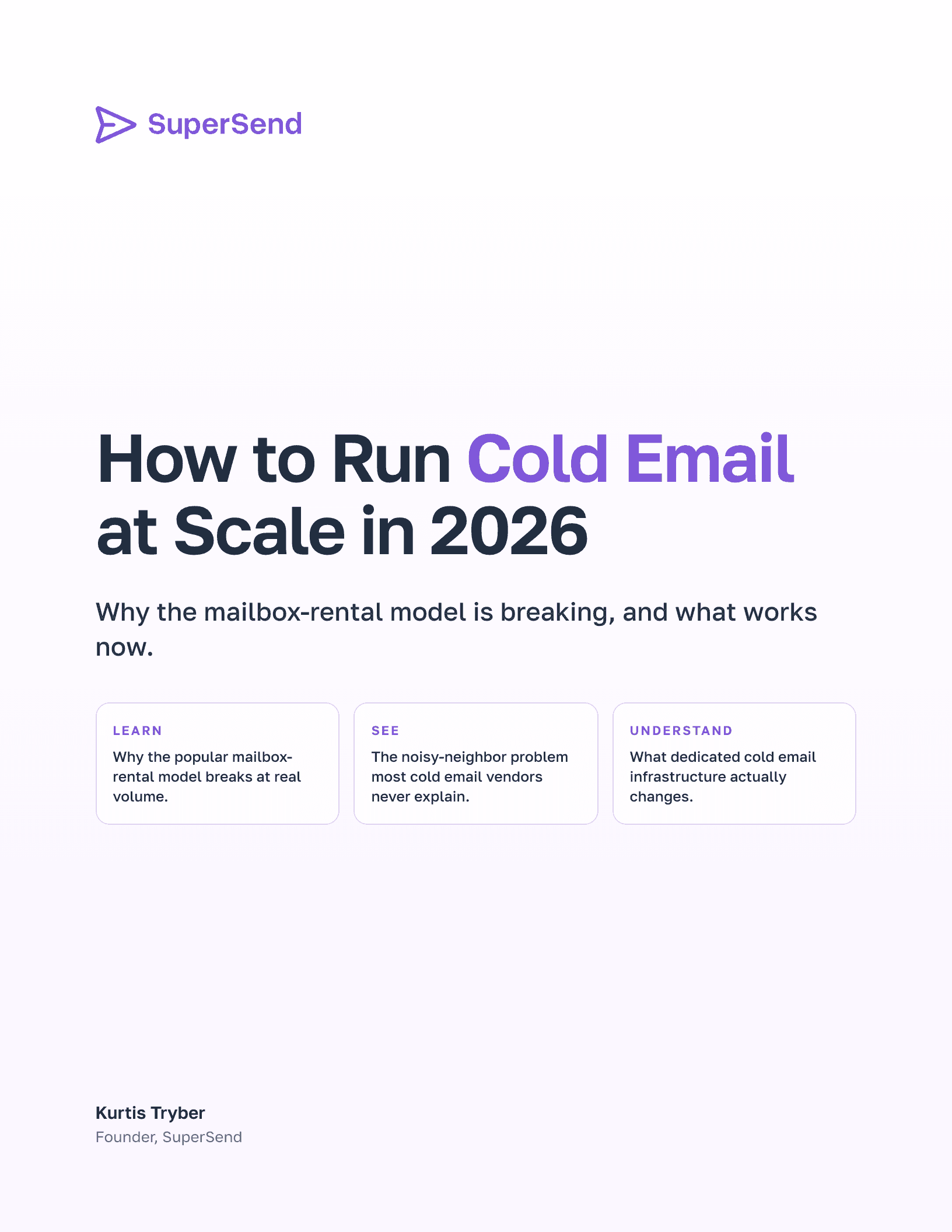
Free playbook · 11 pages
Not ready for a call? Learn what works now.
The old playbook was simple: rent more mailboxes, rotate more domains, add more tools. That model is breaking. This is the founder's breakdown of how serious teams run cold email at scale in 2026, with real numbers from teams sending 200K to 1.3M emails/month.
- Why ESPs (Constant Contact, Mailchimp, Qualtrics) fail at cold and always will
- Why renting Google and Outlook mailboxes burns out every 60 days
- What dedicated cold email infrastructure actually looks like at serious volume
Cold email service FAQ
Is this software I run or are you running it for me?
Both. SuperSend is software your team operates day-to-day for campaigns, sequences, and reply management. We set up and manage the dedicated mail servers, IPs, warmup, and placement testing underneath. Your account manager handles infrastructure scaling as your volume grows.
Do you write copy, source leads, or run campaigns for me?
No. The setup is infrastructure and software only. You bring the offer, copy, lead list, and sales process. This is not an agency or SDR service.
Can you migrate me off Instantly, Smartlead, or Constant Contact?
Yes. Migration support is part of the setup. We move campaigns, contacts, reply routing, and sender configuration so your existing motion keeps running while infrastructure transitions.
What actually changed in 2024 that broke the old cold email playbook?
In February 2024, Google rolled out new bulk-sender requirements (SPF, DKIM, DMARC, one-click unsubscribe, spam-rate thresholds). Microsoft tightened acceptable-use enforcement around bulk outbound around the same time. Combined, these changes made it much harder to run cold email through rented mailboxes or marketing platforms. The rental mailbox model still limps along at low volume, but it breaks faster and harder at any real scale.
Does cold email actually violate Google and Outlook terms of service?
Yes. Google Workspace Acceptable Use Policy prohibits using the service to generate, distribute, publish, or facilitate unsolicited mass email. Microsoft Online Services Acceptable Use Policy prohibits transmitting any unsolicited bulk or commercial email. Mailbox shutdowns when you scale cold sends from those platforms are policy enforcement, not random.
How long does setup take?
Four weeks of infrastructure provisioning and warmup. Production cold sends begin in week 5. Volume ramps up over weeks 5 through 8 to your target.
What about pricing?
Pricing is scoped on the setup call based on your volume, current stack, and migration needs.
Book my cold email strategy call
Bring your current platform (Instantly, Smartlead, Constant Contact, mailbox stack), monthly volume, and what is breaking. We will scope the setup.
We'll capture your email, then take you to the calendar.