There is no universal number of sending domains a cold email team needs.
That is frustrating because teams usually want a simple answer. They want to know whether they need five domains, fifty domains, or a completely different setup.
The honest answer is that domain count is a planning output, not a starting point. It depends on volume, sender strategy, reputation risk, target provider mix, ramp speed, and how much operational visibility the team has.
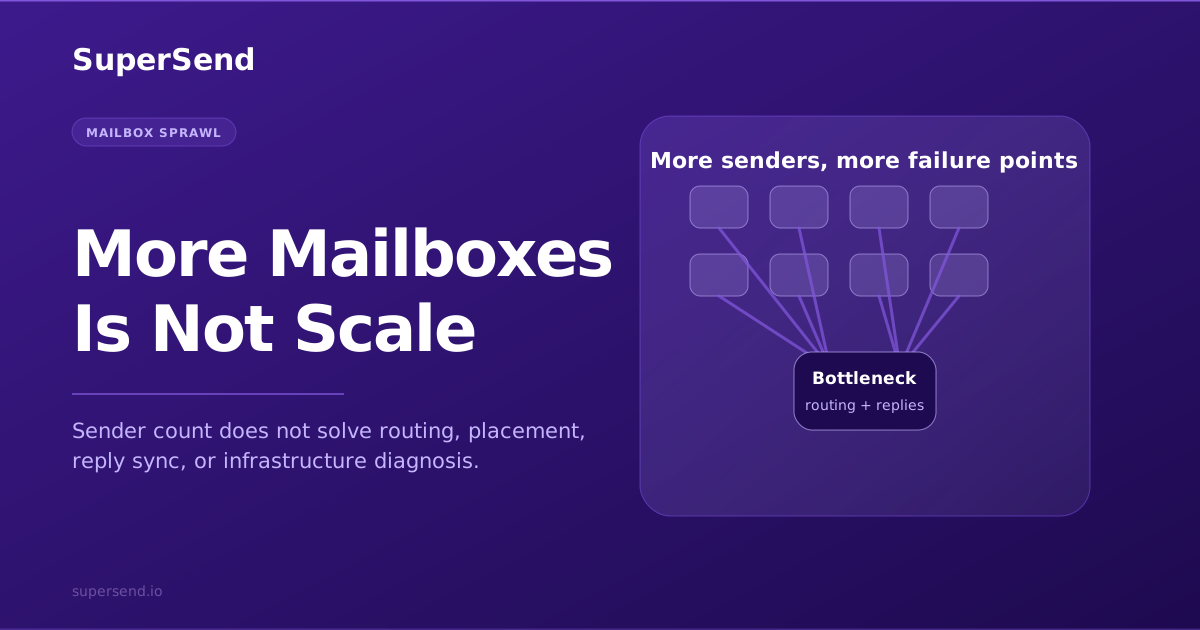
Buying more domains can create capacity. It can also create more surfaces to maintain, monitor, warm, authenticate, and recover. The goal is not to own the most domains. The goal is to build enough healthy sending paths to support your outbound program without turning deliverability into chaos.
Start With Target Volume
Begin with the sending volume you actually need.
A team sending a few thousand cold emails per month has a different domain plan than a team trying to support hundreds of thousands or millions of monthly sends.
Do not start with a vendor's suggested limit. Start with the business requirement:
- How many prospects need to be contacted per month?
- How many steps are in each sequence?
- How many follow-ups are sent per prospect?
- How many regions, personas, industries, or product lines are separated?
- How many senders need to appear human and relevant?
For example, a campaign targeting 20,000 prospects with a four-step sequence is not a 20,000-email campaign. It can become an 80,000-email sending plan before replies, exclusions, bounces, and pacing are considered.
Once you understand real send volume, you can plan the domain and sender pool around the workload.
Do Not Confuse Domains With Sender Identities
A domain is not the same as a sender.
A domain may support multiple sender identities. A sender identity may have its own mailbox, profile, or reply path. Tracking and redirect domains may also be separate from visible sender domains.
That means domain planning has multiple layers:
- Root or sending domains.
- Subdomains.
- Sender identities.
- Tracking domains.
- Reply domains and MX setup.
- Authentication records.
If those are not mapped, adding domains can make the system harder to understand. A team may know it owns 40 domains but not know which ones are active, healthy, warming, damaged, paused, or tied to specific campaigns.
Before adding more, audit what exists. Domain Health for Cold Email is a useful starting point.
Use Domains To Manage Risk, Not Hide Bad Sending
Domain rotation is not a loophole for poor outbound.
If the list is bad, the offer is irrelevant, the volume ramp is reckless, or authentication is broken, more domains will not solve the underlying issue. They may only distribute the damage.
Healthy domain planning helps with:
- Avoiding over-concentration of volume.
- Separating campaigns, brands, geographies, or risk profiles.
- Isolating problems when one domain degrades.
- Creating controlled ramp paths for new outbound motions.
- Supporting growth without sudden spikes on one identity.
Unhealthy domain planning creates:
- Thinly warmed domains with no real history.
- Inconsistent DNS and tracking setup.
- More bounces and complaints across more places.
- Harder investigation when placement drops.
- Fragmented reply management.
The question is not "how many domains can we use?" It is "how many healthy domains can we operate well?"
A Practical Planning Framework
A simple planning model has five inputs.
1. Monthly Send Volume
Estimate monthly email volume across all sequence steps. Then convert that into daily send requirements based on business days and pacing rules.
2. Conservative Daily Load Per Sender
Do not assume every sender can run at the maximum number a provider allows. Cold outbound should be paced below aggressive limits, especially during ramp periods.
3. Sender Identities Per Domain
Some teams prefer fewer senders per domain for simpler isolation. Others operate more identities per domain but monitor carefully. The right answer depends on risk tolerance and operational maturity.
4. Domain Ramp Stage
New domains should not carry the same volume as seasoned domains. Separate domains into stages: new, warming, stable, paused, and retired.
5. Provider Mix
If your market is heavily Gmail, Microsoft, or private business domains, provider-level behavior matters. A domain that performs acceptably in one provider family may struggle in another.
This is why domain count should be paired with inbox placement testing, bounce monitoring, and provider-level reporting.
Example Capacity Model
Use this as a planning example, not a universal rule.
Suppose a team needs to send 120,000 cold emails per month. It sends on 20 business days, so average daily volume is 6,000 messages.
If the team wants a conservative 30 messages per sender per day during normal operation, it needs about 200 active sender identities.
Those sender identities then need to map to domains. If the team uses 4 active senders per domain, it may need around 50 active sending domains, plus spare domains for ramping, testing, paused senders, and recovery.
But the math is only one part of the decision. The team also needs:
- Enough operational capacity to monitor 50 domains.
- Consistent DNS and authentication.
- Placement testing across provider families.
- Bounce categorization.
- Reply routing that does not drown reps.
If those operating pieces are missing, the domain count is not a strategy. It is a spreadsheet.
When More Domains Are A Warning Sign
Sometimes a fast-growing domain footprint is a symptom of a deeper problem.
Watch for these patterns:
- New domains are added because old ones keep degrading.
- No one can explain why a domain was paused.
- Campaigns move domains without a test plan.
- Volume limits are based on folklore, not monitoring.
- The team cannot see placement by provider.
- Replies are scattered across many unmanaged inboxes.
In those cases, the answer may not be more domains. The answer may be better infrastructure, a slower ramp, cleaner lists, or stronger monitoring.
For the operational side of diagnosing issues, read How to Diagnose Cold Email Deliverability Problems.
Where SuperSend Fits
SuperSend helps teams plan and operate outbound infrastructure instead of guessing at mailbox and domain math. Dedicated infrastructure, placement testing, bounce intelligence, domain health, sender health, sequencing, Super Inbox, and API control all matter when the sending footprint grows.
If you are trying to calculate domain needs for a serious outbound program, start with the volume you need, the risk you can tolerate, and the monitoring you have. Then build the domain plan around the operating system, not the other way around.
For broader tooling, see SuperSend free tools, or talk through infrastructure planning on a demo call.
Free playbook · 11 pages
Want the full cold email infrastructure playbook?
Get the founder breakdown on why rented mailbox stacks are breaking and what dedicated cold email infrastructure looks like now.