Most outbound teams do not start by asking what infrastructure their emails run on.
They ask easier questions first: What sequencer should we use? How many steps should the campaign have? Should the first line be personalized? Should we buy more domains?
Those questions matter, but they sit above the sending layer. Underneath every cold email program is a pipe: the servers, IPs, DNS records, authentication, and provider rules that decide how mail leaves your system and how receiving providers evaluate it.
That is where shared ESPs and dedicated mail servers diverge.
A shared ESP can be the right tool for many types of email. A dedicated mail-server setup can be the right tool when cold outbound becomes a serious, high-volume acquisition channel. The mistake is pretending those are the same job.
What a Shared ESP Is
An ESP, or email service provider, is a platform that sends email on behalf of many customers. Examples include transactional and marketing providers such as SendGrid, Mailgun, Amazon SES, Mailchimp-style marketing platforms, and other hosted sending services.
In a shared setup, your email is sent through infrastructure also used by other senders. That usually means some combination of shared IP pools, shared routing, provider-managed authentication tools, and provider-managed abuse controls.
Shared infrastructure has real advantages:
- It is easier to start.
- The provider manages the mail-server layer.
- The provider can smooth traffic across many customers.
- Low-volume or inconsistent senders do not have to build IP reputation from scratch.
- You avoid the operational burden of running your own sending pipes.
Amazon SES documentation describes this tradeoff clearly. New SES accounts send from shared IP addresses by default. AWS notes that shared IPs are ready to use immediately and can be a good fit for lower-volume or less predictable sending patterns.
That is not a bad thing. Shared infrastructure exists because it is useful.
The problem starts when a team uses a shared ESP for a sending motion the provider was not built to support.
What Dedicated Mail Servers Are
A dedicated mail-server setup gives one sender, or one sending program, more isolated control over the mail path.
The exact implementation can vary. It may include dedicated SMTP servers, dedicated IPs, separate IP pools, dedicated sending domains, custom DNS, enforced pacing, provider-specific routing, and monitoring for bounces, complaints, placement, domain health, and sender health.
The important point is isolation.
With dedicated infrastructure, your reputation story is less blended with unrelated senders. You can decide which traffic goes through which path. You can separate cold outbound from transactional mail. You can ramp new infrastructure on purpose. You can debug problems against known servers, IPs, domains, and sender identities.
This does not mean dedicated infrastructure is automatically better. It means the tradeoff changes.
Shared infrastructure optimizes for convenience. Dedicated infrastructure optimizes for control.
Transactional Email and Cold Outbound Are Different Jobs
The biggest confusion in the market is that people use the word "email" as if all sending has the same risk profile.
It does not.
Transactional email usually goes to people who just took an action: signing up, resetting a password, buying something, requesting a receipt, or using a product workflow. The recipient expects the message. Engagement is usually high. Complaint risk is usually lower when the product experience is legitimate.
Cold outbound is different. The recipient may not know the sender. Engagement is less predictable. Complaint risk is more sensitive to targeting, list quality, message relevance, and volume. Mailbox providers are built to protect recipients, so they evaluate patterns, complaints, authentication, sending history, and reputation signals aggressively.
That is why SuperSend should not be framed as a replacement for transactional ESPs. Transactional ESPs are good at their job. Cold outbound infrastructure is a different job.
When cold outbound gets serious, the sending layer needs controls that a normal transactional or marketing setup may not expose deeply enough:
- Sender and domain-level capacity controls
- Dedicated IP or dedicated server strategy
- Provider-level placement visibility
- Bounce and complaint handling
- Gradual ramping of new infrastructure
- Separation of traffic by use case
- API-level control for RevOps and engineering workflows
If the email is part of your revenue engine, the pipe matters as much as the template.
Shared IP Reputation Is Shared Risk
One of the most concrete differences is IP reputation.
Google's email sender guidelines define a shared IP address as an IP address used by more than one sender. Google states that the activity of any sender using a shared IP affects the reputation of all senders on that IP, and that negative reputation can affect delivery.
That does not mean every shared IP is bad. Good providers invest heavily in abuse prevention and pool management. But it does mean the sender has less isolation.
AWS makes the same distinction in its SES docs. Dedicated IPs are reserved for one sender's use and allow the sender to control and isolate reputation. Shared IPs are easier to start with, but reputation is managed as part of the shared pool.
For cold outbound, that distinction matters because the risk profile is different from password resets or receipts. If a cold outbound program is large enough to justify dedicated infrastructure, it should not be forced to inherit reputation dynamics from unrelated senders.
Dedicated Infrastructure Still Requires Discipline
Dedicated does not mean guaranteed.
A dedicated IP can perform worse than a shared IP if the sender behaves badly. Sudden volume spikes, poor list quality, high complaints, missing authentication, and weak bounce handling will damage reputation on any path.
AWS says IP reputation is based largely on historical sending patterns and volume, and that an IP with consistent sending history typically has a better reputation than one that suddenly starts sending large volume with no history. AWS also notes that standard dedicated IPs require warmup and consistent sending patterns.
Google gives similar operational guidance for volume increases: start low, increase slowly, avoid bursts, monitor server responses, spam rate, and domain reputation, and reduce volume when bounces or deferrals appear.
The lesson is simple: dedicated infrastructure gives you the steering wheel. It does not drive for you.
When Shared Infrastructure Is Fine
Shared infrastructure can be a good choice when:
- You send low volume.
- Your sending pattern is irregular.
- You are sending transactional or product-triggered email.
- You do not need static IPs or infrastructure-level debugging.
- You are not trying to isolate cold outbound reputation from other traffic.
- You are early enough that operational simplicity matters more than control.
For many businesses, this is the correct stage. Buying complexity too early is its own failure mode.
When Dedicated Mail Servers Make Sense
Dedicated infrastructure becomes more compelling when:
- Cold outbound is a material acquisition channel.
- You send at high volume or plan to ramp volume.
- You need to isolate reputation by program, segment, client, or traffic type.
- You need clear ownership of IPs, domains, and sender pools.
- You need placement, bounce, complaint, and sender health visibility.
- You need RevOps or engineering to automate campaign and infrastructure operations.
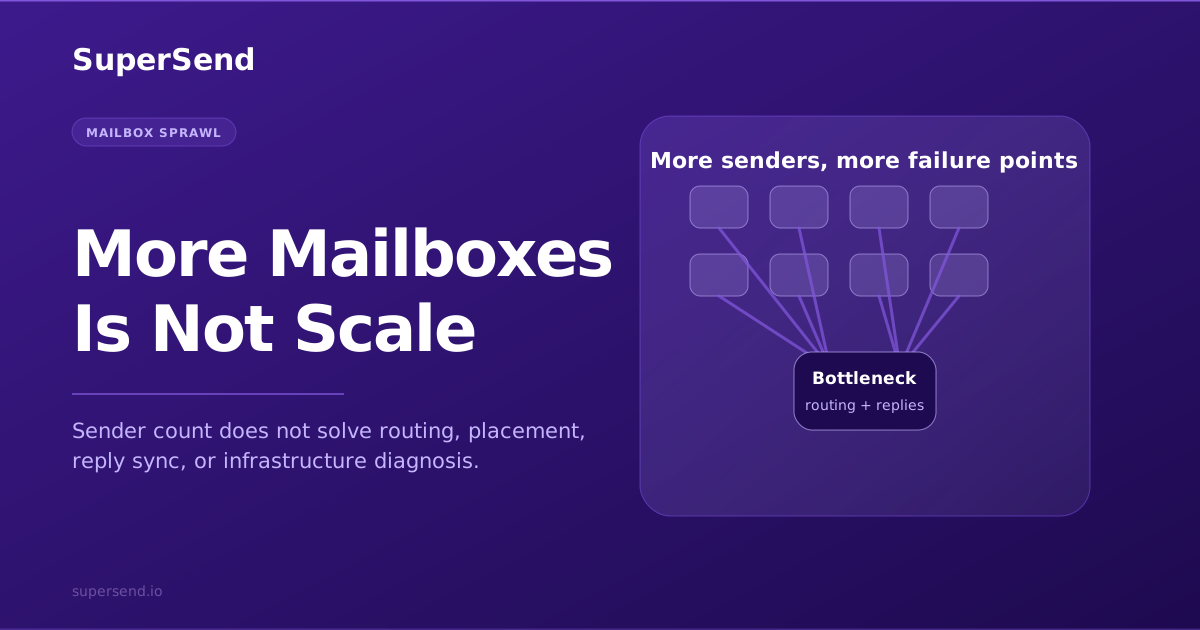
- You have outgrown "just add more inboxes" as an operating model.
This is the enterprise motion.
At that point, the buying question changes from "which sequencer has the nicest campaign editor?" to "what does our outbound actually run on?"
The Questions Buyers Should Ask
Before choosing a sending path, ask:
- Are we sending cold outbound, transactional email, marketing email, or a mix?
- Which domains and IPs will actually carry the mail?
- Are those IPs shared or dedicated?
- Can we separate traffic types so cold outbound does not contaminate transactional mail?
- Are SPF, DKIM, DMARC, TLS, and forward/reverse DNS handled correctly?
- How will new IPs, domains, and senders ramp?
- What happens if Gmail degrades but Microsoft remains healthy, or the reverse?
- Can we see bounces, complaints, placement, and sender health by identity?
- Can our team automate the system through an API instead of managing everything by hand?
If a provider cannot answer those questions clearly, you do not yet understand the pipe.
Where SuperSend Fits
SuperSend is built for high-volume cold outbound teams that need the sequencer and the sending infrastructure to work together.
The sequencing layer runs campaigns. The infrastructure layer carries those campaigns through dedicated servers and IPs, sender identities, DNS, pacing, deliverability monitoring, and reply operations. The API layer gives technical teams a way to integrate outbound into their own systems.
That is the difference between using email software and operating an outbound channel.
Shared ESPs are not bad. They are just not always the right pipe for cold outbound at scale.
Further reading
Free playbook · 11 pages
Want the full cold email infrastructure playbook?
Get the founder breakdown on why rented mailbox stacks are breaking and what dedicated cold email infrastructure looks like now.