Cold email deliverability rarely breaks all at once.
It usually breaks when a team tries to scale a system that was only stable at low volume.
At 50 sends a day, weak infrastructure can hide. At 5,000 or 50,000 sends a day, it cannot. Volume turns small problems into obvious patterns: missing authentication, stale lists, sender overuse, shared IP issues, provider throttling, spam complaints, and reply chaos.
That is why teams often blame the wrong thing.
They rewrite subject lines. They swap sequencers. They buy more domains. They blame "the algorithm." But the real issue is usually simpler: the sending system was not built to carry the new load.
Scale Changes the Signal
Mailbox providers do not evaluate your email in isolation. They evaluate patterns.
Patterns include volume, frequency, authentication, recipient feedback, spam complaints, bounces, deferrals, domain reputation, IP reputation, message similarity, and historical behavior.
At low volume, those signals may not be strong enough to trigger obvious problems. At higher volume, the same weaknesses become easier for receiving systems to detect.
Google's sender guidelines make this explicit. Google says that the amount of email sent affects how quickly senders should increase volume, that senders should start with low volume and increase slowly, and that sudden volume increases can result in rate limiting or reputation drops.
This is the first scaling lesson: more volume is not just more throughput. It is a stronger reputation signal.
Failure 1: Volume Ramps Too Fast
New domains, new senders, and new IPs need history.
If a sending path suddenly jumps from no history to heavy volume, receiving systems have little evidence that the traffic is wanted. That can lead to rate limits, deferrals, spam placement, or reputation drops.
Amazon SES documentation says IP reputation is based largely on historical sending patterns and volume. AWS also notes that an IP with a consistent sending history usually has a better reputation than one that suddenly starts sending large volume with no prior history.
Google gives the operational version: increase volume slowly, avoid bursts, monitor server responses, and reduce volume when bounces or deferrals appear.
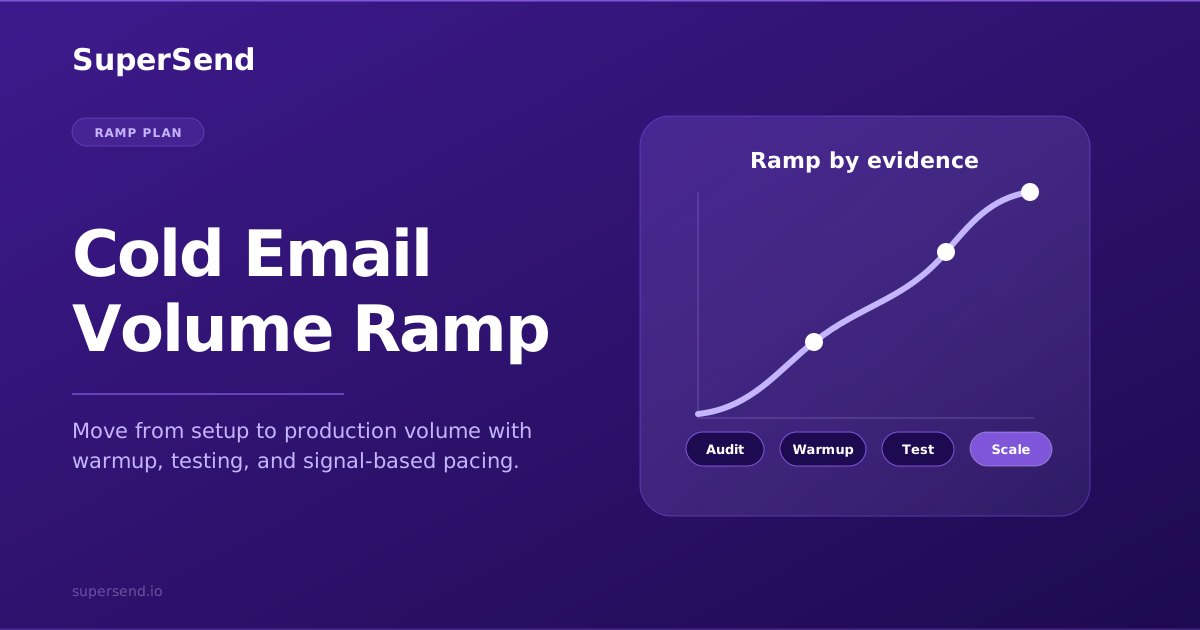
The fix is not "send less forever." The fix is to ramp deliberately.
Failure 2: Shared Reputation Creates Confusion
On shared infrastructure, your mail can inherit some of the reputation dynamics of a pool.
Google defines a shared IP as one used by more than one sender and says activity from any sender on that shared IP affects the reputation of all senders using it. AWS describes shared IPs as easy to start with, but dedicated IPs as a way to isolate reputation and control sender reputation.
At small volume, shared infrastructure may be fine. At serious cold outbound volume, shared reputation makes troubleshooting harder.
If placement drops, is it your traffic, your domain, your content, your list, or the shared pool? If Gmail starts throttling but Microsoft holds, where is the problem? If one customer segment performs badly, can you isolate it from the rest of the program?
Scale demands cleaner boundaries.
Failure 3: Authentication Is Incomplete or Misaligned
SPF, DKIM, and DMARC are not advanced deliverability tactics anymore. They are baseline sending requirements.
Google requires all senders to Gmail accounts to set up SPF or DKIM. For senders above 5,000 messages per day to Gmail accounts, Google requires SPF, DKIM, and DMARC. Yahoo's sender requirements also emphasize SPF, DKIM, DMARC, and alignment for bulk senders.
At low volume, incomplete authentication may appear to work until it does not. At high volume, the margin disappears.
Common problems include:
- SPF does not include the active sender.
- DKIM is not enabled for a sending domain.
- DMARC exists but does not align with the visible From domain.
- A domain migration leaves stale DNS behind.
- A new provider is added without updating authentication.
When scale breaks deliverability, authentication should be one of the first checks.
Failure 4: Forward and Reverse DNS Are Sloppy
Mail servers need a clean technical identity.
Google says sending domains or IPs should have valid forward and reverse DNS records. The sending IP should have a PTR record that resolves to a hostname, and that hostname should resolve back to the same IP through an A or AAAA record.
Yahoo also calls out valid forward and reverse DNS records for sending IPs.
This matters more when you operate SMTP or dedicated sending infrastructure. If the server identity looks sloppy, the receiving side has less reason to trust the path.
At scale, small DNS mistakes become repeated evidence.
Failure 5: Lists Get Worse as Volume Expands
Scaling often changes list quality.
The first campaigns may use a highly curated segment. The next stage adds broader accounts, older data, scraped contacts, weaker enrichment, or less relevant personas. Bounce rates rise. Negative replies increase. Spam complaints show up.
Infrastructure cannot save bad inputs.
Yahoo recommends removing invalid recipients and monitoring hard and soft bounces. Google recommends sending only to people who want messages in its subscription guidance and emphasizes recipient feedback when increasing volume.
Cold outbound is not permission-based marketing, so the practical standard is different. But the operating lesson still applies: recipient quality affects reputation.
If list quality declines as volume grows, deliverability will eventually reflect it.
Failure 6: Provider Behavior Diverges
"Deliverability" is not one score.
Gmail, Microsoft, Yahoo, AOL, and private business domains can behave differently. A campaign can land well in one provider family and poorly in another. A sender can look healthy overall while one provider is quietly degrading.
That is why placement testing and provider-level monitoring matter.
A placement test is only a snapshot, but it helps identify provider divergence. Bounce and deferral data help show whether a receiving system is slowing or rejecting traffic. Complaint signals show whether recipients are reacting negatively.
At scale, average metrics hide the problem. Provider-level signals reveal it.
Failure 7: Reply Operations Break
Deliverability is not only about reaching the inbox. It is also about operating the channel after the inbox.
When sender count grows, replies scatter. Interested buyers land in different inboxes. Out-of-office replies hide real timing signals. Unsubscribes and negative replies may not get processed quickly. Sales teams miss context.
That creates downstream deliverability risk too.
If unsubscribes, complaints, or negative signals are not handled, the team keeps sending into bad feedback. If interested replies are missed, the channel looks weaker than it is.
Scaling outbound requires centralized reply operations, not just more senders.
Failure 8: The Sequencer Is Treated Like the Infrastructure
A sequencer schedules messages. Infrastructure carries them.
The sequencer matters, but it cannot override a damaged domain, a cold IP, a bad PTR record, a high complaint rate, or an overloaded sender. When teams treat the campaign tool as the whole system, they miss the actual failure points.
At scale, the system includes:
- Domains
- Sender identities
- SMTP servers or relays
- IP strategy
- DNS and authentication
- Volume caps
- Warmup and ramping
- Bounce and complaint handling
- Placement monitoring
- Reply management
- API and operational workflows
The sequencer is one layer. It is not the whole machine.
What To Do Before You Add Volume
Before increasing cold outbound volume, check:
- Are SPF, DKIM, DMARC, PTR, A/AAAA, and MX records correct?
- Are cold outbound and transactional/customer mail separated?
- Do you know which servers, IPs, domains, and senders carry each campaign?
- Are new senders, domains, and IPs ramping gradually?
- Are volume caps set by sender, domain, IP, and provider?
- Are bounces, deferrals, and blocks categorized?
- Are complaint signals watched where available?
- Are placement tests run when infrastructure changes?
- Are replies centralized and processed?
- Can the team pause or rebalance sending quickly?
If the answer is no, adding volume will expose the weak point.
Where SuperSend Fits
SuperSend exists for teams that have outgrown fragile outbound stacks.
The product combines sequencing with dedicated infrastructure, deliverability monitoring, Super Inbox, and API control. That matters because scaling cold outbound is not just about sending more messages. It is about operating the full sending system with enough visibility to know when to accelerate, pause, or rebalance.
Cold email deliverability breaks when scale exposes what the infrastructure cannot handle.
The solution is not a better subject line alone. It is a better pipe, better monitoring, and a better operating model.
Further reading
Free playbook · 11 pages
Want the full cold email infrastructure playbook?
Get the founder breakdown on why rented mailbox stacks are breaking and what dedicated cold email infrastructure looks like now.