High-volume cold email is not just cold email with a bigger send limit.
At low volume, the platform question is usually simple: can the team build sequences, connect senders, upload lists, personalize messages, and track replies?
At high volume, the platform question changes.
The team needs to know what the sending program runs on, how capacity is scoped, how sender health is monitored, how placement problems are diagnosed, how replies get routed, and how the outbound system connects to the rest of the revenue stack.
That is why a high-volume cold email platform cannot be judged only by sequencer features.
Sequencing matters. But serious outbound fails when the sending layer, deliverability layer, and operations layer cannot carry the program.
The Short Version
A high-volume cold email platform should combine four jobs:
| Job | Why it matters at volume |
|---|---|
| Dedicated sending infrastructure | The team needs known servers, IPs, sender identities, routing, and capacity |
| Sequencing | Campaign logic still needs to run across the sender pool |
| Deliverability monitoring | Operators need placement, bounce, sender, domain, and list-quality signals |
| Reply and API operations | Replies, CRM workflows, reporting, and automation cannot live in scattered inboxes |
If a platform only solves sequencing, the team still has to build the rest of the operating model around it.
That can work for smaller outbound motions. It breaks down when cold email becomes a serious acquisition channel.
Why "Unlimited Sending" Is The Wrong Frame
The easiest way to market high-volume cold email is to talk about unlimited inboxes, unlimited sends, or unlimited campaigns.
That language is attractive because it sounds like scale.
But volume is not the same as capacity.
Real capacity depends on:
- Sender identity health
- Domain history
- DNS and authentication
- Dedicated or shared IP behavior
- Provider-level acceptance
- Recipient quality
- Bounce patterns
- Complaint risk
- Pacing and ramp discipline
- Reply handling capacity
If those pieces are weak, "unlimited" only means the team can create a larger deliverability problem faster.
High-volume outbound needs controlled capacity. The right question is not "how many emails can the software attempt to send?" The right question is "what volume can the infrastructure support while keeping the program observable?"
The Four Platform Categories Buyers Confuse
Enterprise buyers often compare very different tools as if they do the same job.
They do not.
1. Mailbox-based sequencers
Mailbox-based sequencers are useful when the team needs a fast way to launch campaigns through connected senders.
They help with:
- Sequences
- Personalization
- Sender assignment
- Basic reply handling
- Campaign analytics
They are often the right first platform.
But the buyer still owns much of the infrastructure burden: domains, mailbox procurement, DNS, sender health, capacity planning, placement testing, and provider-level diagnosis.
2. Infrastructure tools
Infrastructure tools help with domains, mailboxes, DNS, inbox hosting, warmup, or dedicated IPs.
They can be valuable, especially when the team has a strong operator who knows how to connect the pieces.
But infrastructure alone is not the full outbound platform. The team still needs sequencing, reply operations, monitoring, campaign controls, and integration into the revenue workflow.
3. Sales engagement platforms
Sales engagement platforms are built around sales team workflows: cadences, calls, LinkedIn steps, CRM sync, tasks, and rep activity.
They can support enterprise sales teams, but they are not usually designed to own the cold email sending infrastructure underneath the motion.
For high-volume cold outbound, that distinction matters.
4. Managed dedicated outbound platforms
This is where SuperSend fits.
A managed dedicated outbound platform combines the sending foundation with the campaign layer and operating layer:
- Dedicated email servers and IPs
- Sender identities and capacity planning
- Sequencing across the sender pool
- Placement and deliverability monitoring
- Bounce, domain, and sender health signals
- Unified reply management
- REST API and webhooks
The goal is not to replace every revenue tool. The goal is to make cold outbound run on a system that can be scoped, monitored, and operated at volume.
What High-Volume Teams Actually Need
Once outbound becomes a serious channel, the team needs more than campaign features.
A known sending foundation
High-volume teams need to know what their outbound runs on.
That includes servers, IPs, sender identities, domains, authentication, routing, and capacity. If the sending path is hidden, the team cannot diagnose the system when performance changes.
This is why enterprise cold email infrastructure starts with the managed sending layer, not the sequence builder.
Sender capacity without chaos
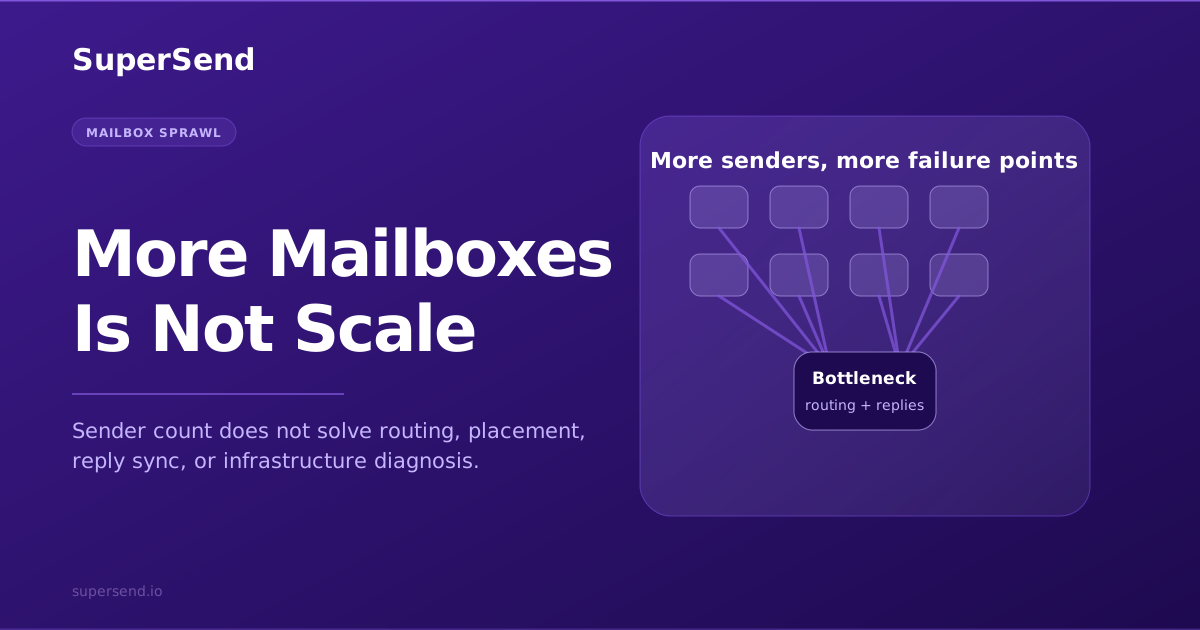
More senders can help distribute volume, but only if the program can manage them.
High-volume platforms need a way to understand:
- Which senders are active
- Which sender pools carry which campaigns
- Which identities are paused, warming, or degrading
- Which domains are healthy enough for more volume
- Which campaigns should slow down or move capacity
Without that operating model, sender scale becomes mailbox sprawl.
Deliverability signals that lead to action
At high volume, averages hide problems.
A blended reply rate can look acceptable while one provider is filtering heavily. A global bounce rate can hide one bad list segment. A sender can look fine in a warmup tool while real recipient placement is declining.
The platform needs to expose signals that operators can act on:
- Inbox placement
- Bounce categories
- Sender health
- Domain health
- DNS state
- Validation outcomes
- Provider-level patterns
The point is not to create more dashboards. The point is to know whether to keep sending, slow down, isolate, fix, rotate, or pause.
Reply operations across the sender pool
High-volume cold email creates reply volume and reply fragmentation.
Interested replies, referrals, objections, unsubscribe requests, auto-replies, and risk signals can arrive across many sender identities. If those replies live in disconnected inboxes, the team loses pipeline and feedback.
A high-volume platform needs reply operations, not just reply collection.
Super Inbox exists for this reason: replies across many identities need one place to be triaged and acted on.
Programmatic control
Enterprise outbound often involves RevOps, data teams, enrichment workflows, CRM logic, reporting, and internal systems.
That is where API and webhooks become part of the buying decision.
A high-volume cold email platform should not trap every operation inside a dashboard. The team should be able to connect campaigns, contacts, senders, validation, placement tests, replies, and webhooks to the systems around outbound.
SuperSend documents its API at docs.supersend.io. The exact implementation belongs in the docs, but the business reason is simple: enterprise outbound needs a control plane.
Buying Checklist
Before choosing a high-volume cold email platform, ask:
- What does the sending run on?
- Are IPs, domains, sender identities, and routing known?
- Does the platform provide dedicated infrastructure or simply connect mailboxes?
- How does capacity get scoped before volume increases?
- What happens when placement drops at one provider?
- Can the team see bounce categories by sender, domain, and campaign?
- How are replies triaged across many sending identities?
- Can RevOps connect the platform through API and webhooks?
- What does migration look like from the current setup?
- What should not run through this platform?
If those questions cannot be answered clearly, the platform may be strong software but weak infrastructure.
Where SuperSend Fits
SuperSend is for teams that have outgrown mailbox-based cold email and need a managed dedicated outbound platform.
It brings together email sending infrastructure, sequencing, deliverability monitoring, Super Inbox, and API/webhooks so the team can run cold outbound as an operating system instead of a collection of disconnected tools.
SuperSend is not the right fit if the team only needs a lightweight sequencer or a cheap way to send a few campaigns.
It is the right fit when cold outbound has become important enough that the sending layer needs to be scoped, monitored, and managed.
If that is where your team is, read Enterprise Cold Email Infrastructure, then book a demo to talk through the sending layer behind your current and target volume.
Free playbook · 11 pages
Want the full cold email infrastructure playbook?
Get the founder breakdown on why rented mailbox stacks are breaking and what dedicated cold email infrastructure looks like now.