Enterprise cold email is not a bigger version of a small cold email campaign.
At small volume, a team can make outbound work with a sequencer, a handful of connected inboxes, basic domain setup, and enough manual attention to notice when something breaks.
At enterprise volume, that model starts to fail.
The problem is not only the campaign UI. The problem is the operating layer underneath the campaign: the servers, IPs, sender identities, domains, routing rules, pacing limits, placement signals, bounce feedback, reply routing, and API control that decide whether outbound can keep moving without becoming a mailbox management project.
That operating layer is enterprise cold email infrastructure.
Most of the market still describes cold email infrastructure as domains, inboxes, DNS records, warmup, and a connection to a sequencer. Those pieces matter. But they are not enough for teams that need cold outbound to behave like a durable acquisition channel.
Enterprise teams need a managed sending foundation: dedicated email servers and dedicated IPs, sender capacity that is scoped to the program, deliverability monitoring that explains what is happening, sequencing that runs on top of the infrastructure, unified reply operations, and API/webhook control for the systems around it.
That is the category SuperSend is built for.
The Short Version
Enterprise cold email infrastructure is the managed sending system behind high-volume cold outbound.
It is not just a sequencer.
It is not just a mailbox provider.
It is not a transactional email service.
It is the operating layer that lets a team send, monitor, route, and improve outbound across many sender identities without relying on fragile mailbox hacks or shared sending pools.
| Layer | Mailbox-based cold email | Enterprise cold email infrastructure |
|---|---|---|
| Sending foundation | Connected inboxes and sender accounts | Dedicated servers, dedicated IPs, sender identities, and managed routing |
| Scale model | Add more inboxes and domains | Scope capacity, pacing, sender pools, and monitoring around the program |
| Deliverability view | Operator pieces together DNS, bounces, warmup, and placement | Placement, bounce, sender, and domain health are part of the operating model |
| Reply operations | Replies spread across identities unless manually organized | Unified reply management across the sender pool |
| Program control | Mostly dashboard-driven | Dashboard plus REST API and webhooks for enterprise workflows |
| Best fit | Starting or scaling a basic outbound motion | Teams where cold outbound is an important channel and the sending layer cannot be fragile |
If your team mostly needs to launch campaigns, a mailbox-based sequencer may be enough.
If your team needs cold outbound to run at serious volume with infrastructure ownership, deliverability visibility, reply operations, and programmatic control, you should evaluate enterprise cold email infrastructure.
Why the Market Is Confusing
The cold email market uses the same words for very different jobs.
"Cold email software" can mean a Gmail plugin, a sales engagement platform, a lead database with email steps, a mailbox sequencer, a warmup tool, an inbox provider, an SMTP relay, a deliverability checker, or a full outbound operating layer.
That confusion creates bad buying decisions.
A team with an infrastructure problem buys another campaign UI.
A team with a reply operations problem buys more inboxes.
A team with a deliverability visibility problem buys a warmup subscription.
A team with a sender capacity problem keeps adding domains until nobody knows which identity, IP, or provider is responsible for the current placement issue.
Enterprise cold email infrastructure starts by separating those jobs.
- Sequencing decides who gets which message and when.
- Sending infrastructure decides what path the message takes.
- Deliverability monitoring explains whether that path is healthy.
- Reply operations decide how interested responses and failure signals get triaged.
- API and webhooks let the team connect outbound to CRM, data, internal tools, and reporting.
When those jobs are separated, the buyer can diagnose the actual bottleneck.
When they are blurred together, every problem looks like "we need another tool."
What Enterprise Cold Email Infrastructure Includes
Enterprise cold email infrastructure has more moving parts than a normal mailbox workflow. The point is not complexity for its own sake. The point is ownership.
Dedicated sending environment
At serious volume, the sending path matters.
Dedicated email servers and dedicated IPs give the outbound program an isolated foundation. The team is no longer depending entirely on a shared pool where another sender's behavior can confuse the reputation picture.
Dedicated infrastructure does not magically guarantee inbox placement. Nothing does. But it gives the team a cleaner operating surface:
- Known servers
- Known IPs
- Known sender identities
- Known routing behavior
- Known volume limits
- Known reputation signals
That is the difference between "we think something is wrong with deliverability" and "this sender pool, on this domain set, through this infrastructure path, started degrading after this change."
Sender identities and domain inventory
Enterprise outbound usually involves more than one sender.
There may be multiple domains, subdomains, sender profiles, reply identities, business units, offers, geographies, and recipient segments. Without a managed inventory, the system becomes tribal knowledge.
Good infrastructure keeps the sending identity clear:
- Which domain is used for which motion
- Which sender identity belongs to which campaign
- Which IP or server path carries the mail
- Which reply path receives responses
- Which domains are warming, active, paused, or retired
The goal is not to create a giant sender farm. The goal is controlled capacity.
Authentication and DNS hygiene
SPF, DKIM, DMARC, MX, A/AAAA, tracking domains, redirect domains, and reverse DNS are not "setup chores" at enterprise volume. They are part of the sending identity.
Bad DNS can create rejection, spam placement, misalignment, broken tracking, or inconsistent provider behavior.
Enterprise infrastructure treats authentication as a managed baseline, not a one-time checklist someone completed during onboarding.
This matters even more when a team is migrating from a fragile setup. If DNS, sending domains, tracking domains, and reply paths move without a plan, the migration itself can become the deliverability incident.
Pacing and capacity control
High-volume cold email fails when teams treat capacity as a spreadsheet number.
Real capacity depends on sender age, domain health, IP behavior, list quality, recipient provider mix, bounce patterns, complaint risk, and placement signals. Sending more because there are more inboxes available is not a strategy.
Enterprise cold email infrastructure needs pacing rules:
- How quickly new infrastructure ramps
- Which sender pools carry which campaigns
- When to slow down
- When to isolate a sender or domain
- When to pause a campaign
- How to avoid bursts that make a new sending path look abnormal
Sequencers can schedule messages. Infrastructure needs to decide what the sending system can responsibly carry.
Deliverability monitoring
Deliverability is not one metric.
Open rates are noisy. Bounce rates are delayed. Warmup dashboards can make a sender look healthier than real recipient behavior suggests. Spam placement can happen before revenue teams notice the pipeline impact.
Enterprise teams need multiple signals:
- Inbox placement tests
- Bounce categories
- Domain health
- Sender health
- DNS status
- Validation results
- Provider-specific patterns
- Campaign and sender-level degradation
The value is not a pretty dashboard. The value is decision support.
Should the team keep sending, slow the ramp, rotate capacity, clean a list, fix DNS, isolate a sender, or pause the campaign?
That is the question deliverability monitoring should answer.
Reply operations
When outbound scales, replies become infrastructure too.
Interested replies, referrals, objections, out-of-office messages, unsubscribe requests, bounces, and risk signals can arrive across many sender identities. If those replies live in separate inboxes, the team loses both revenue and operational feedback.
Enterprise cold email infrastructure needs unified reply operations:
- One place to triage replies across sender identities
- Labels or workflows that separate sales opportunities from noise
- Visibility into failure signals
- Routing that keeps ownership clear
- A process for turning replies into action
The sending system is not successful because emails left the server. It is successful when the right replies reach the right people fast enough to create pipeline.
API and webhooks
Enterprise buyers eventually need more than a dashboard.
They need to connect outbound to CRM, data enrichment, internal reporting, compliance workflows, lead routing, custom dashboards, and automation. That is why REST API and webhooks matter.
API is not a developer checkbox. It is proof that the platform can participate in the operating system around revenue.
For SuperSend, API and webhooks are part of the enterprise story: campaign operations, contacts, sequences, senders, sender profiles, managed domains and mailboxes, placement tests, validation, webhooks, teams, and integrations are documented at docs.supersend.io. The exact technical implementation should always be checked against the docs, but the strategic point is simple:
If cold outbound is mission-critical, it cannot be trapped inside a manual dashboard.
What This Is Not
Enterprise cold email infrastructure is not the same as a transactional email provider.
Transactional ESPs are built for product email: password resets, receipts, alerts, notifications, and lifecycle messages. Those systems have different recipient expectations and different reputation dynamics than cold outbound.
Enterprise cold email infrastructure is also not the same as marketing email software. Newsletter and lifecycle platforms are built around opted-in audiences, templates, campaigns, and compliance workflows for subscribers.
It is not a sales engagement platform first. Sales engagement tools can be useful, especially for sales teams managing multichannel activity, but they usually assume the sending layer is already solved or delegated to connected inboxes.
It is not "buy more inboxes."
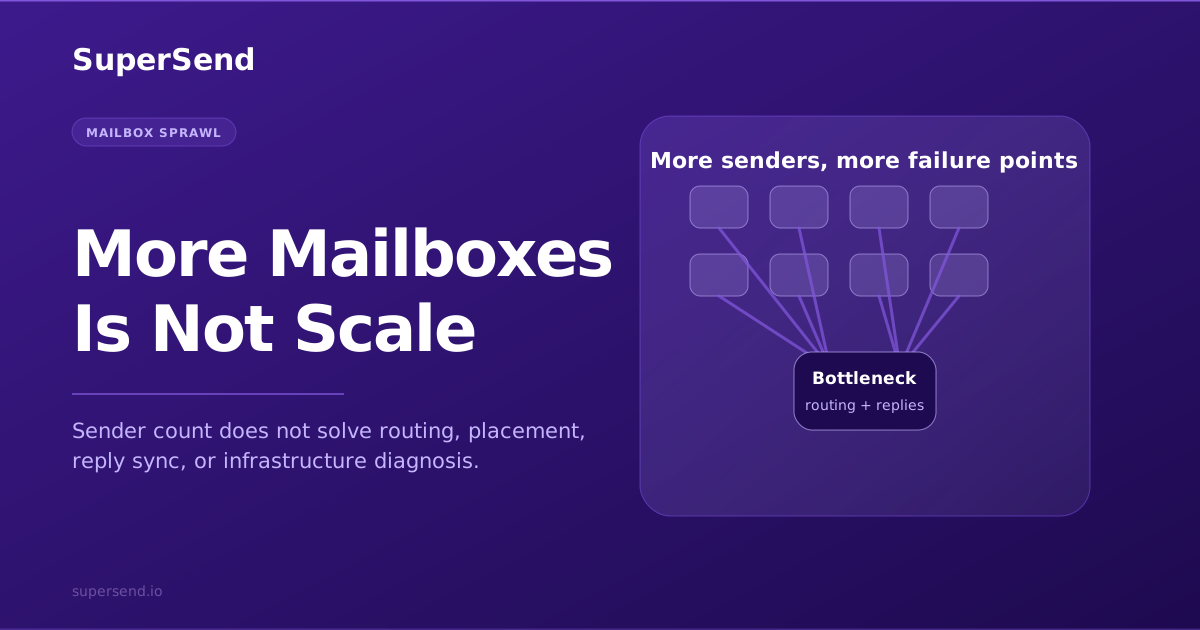
More inboxes can add capacity, but they do not automatically create operational clarity. If the team cannot explain which senders are healthy, which domains are at risk, which infrastructure path is degrading, and which replies need action, more inboxes may only create more places for the same problem to hide.
When a Team Needs Enterprise Infrastructure
A team usually does not wake up one day and decide to buy enterprise cold email infrastructure because it sounds nice.
They need it because the old system starts creating pain.
Common signs:
- The team is sending enough volume that mailbox-by-mailbox management is no longer realistic.
- Campaign performance changes and nobody can tell whether the issue is list quality, copy, DNS, sender health, provider behavior, or infrastructure.
- Reply handling is spread across too many identities.
- Sender assignment is manual and brittle.
- Shared providers or rented mailboxes create unclear reputation risk.
- The team needs reporting and automation that cannot live only inside a sequencer.
- Migration risk has become a board-level or revenue-leader concern because outbound is a real channel.
This is the moment when the buying question changes.
The question is no longer:
Which tool can send a sequence?
The question becomes:
What should our outbound run on?
The Enterprise Buying Checklist
When evaluating cold email infrastructure, do not start with a feature grid.
Start with the operating model.
Ask:
- What is the sending foundation? Dedicated servers, dedicated IPs, connected mailboxes, shared pools, or some mix?
- Who owns setup and health? Is infrastructure managed, or does the customer stitch together domains, DNS, inboxes, and routing?
- How is capacity scoped? Does the system plan around volume, sender pools, pacing, and recipient provider behavior?
- How is deliverability monitored? Placement, bounces, DNS, validation, sender health, and domain health should feed decisions.
- How are replies handled? Can the team operate replies across many senders without losing revenue signals?
- How does migration work? What happens to domains, sender identities, tracking, replies, campaigns, and ramp timing?
- Can the platform integrate with the rest of the revenue stack? API and webhooks matter when the workflow is bigger than one dashboard.
- What should not run here? Cold outbound should be separated from transactional and customer-facing email.
Those questions expose the difference between a campaign tool and an infrastructure platform.
Where SuperSend Fits
SuperSend is built for teams that have outgrown cold email hacks.
The platform combines dedicated email servers and dedicated IPs with campaign sequencing, deliverability monitoring, Super Inbox, and REST API/webhooks. The goal is not to help a small team send its first few emails. The goal is to help serious outbound teams run cold email on a managed infrastructure layer they can scale, monitor, and operate.
That means SuperSend is a fit when:
- The sending layer is the bottleneck.
- The team needs dedicated infrastructure, not another shared pool.
- Deliverability decisions need better signal.
- Replies across many sender identities need one operating workflow.
- The revenue team needs API and webhook control for programmatic operations.
- Migration away from a fragile setup needs to be planned, not improvised.
SuperSend is not the right fit if all you need is a lightweight sequencer, a newsletter platform, a transactional ESP, or a cheap mailbox bundle.
But if cold outbound is becoming an enterprise acquisition system, the infrastructure underneath it needs to be treated like infrastructure.
That is the category.
That is where SuperSend belongs.
What To Read Next
If you are mapping the sending layer, start with What Is SMTP Infrastructure for Cold Email?.
If you are deciding between shared and dedicated paths, read Shared ESPs vs Dedicated Mail Servers for Cold Outbound and Why Dedicated IPs Matter for High-Volume Cold Email.
If your current setup is already breaking, use The Enterprise Cold Email Infrastructure Checklist and How To Migrate Cold Email Off Shared ESP Infrastructure.
If you are evaluating SuperSend, start with the email sending infrastructure page or book a demo to scope the sending layer around your actual volume and operating needs.
Free playbook · 11 pages
Want the full cold email infrastructure playbook?
Get the founder breakdown on why rented mailbox stacks are breaking and what dedicated cold email infrastructure looks like now.