Most people who search for Instantly alternatives are not unhappy with sending. They hit a contact cap. Instantly's pricing page lists the Growth plan at $47 a month with 1,000 uploaded contacts and 5,000 emails a month, and the next tier, Hypergrowth, at $97. A founder with a 3,000-row list and a modest send volume ends up paying for a tier sized to a list, not to the emails that actually go out. Our view is that contacts should be free to add and the bill should follow email volume. A list is a spreadsheet; the thing that costs a vendor money, and the thing that can hurt your domain, is the send. This page compares six tools on that question, plus warmup, LinkedIn steps and reply handling, using each vendor's own pricing page as read on October 4, 2026.
Who this page is for
Founders and sales teams of one to five people who run their own outbound, send from their own Google or Outlook inboxes or want to buy a few, and want cold email and LinkedIn in one place. If you run outreach for clients, the agency plans and white-label options on these pages matter more than anything here, and this page does not weigh them. If you are picking a first tool rather than leaving Instantly, start with our comparison of the best cold email software for founders.
Why people look past Instantly
Three things come up again and again, and Instantly's own pages confirm the structure behind each.
Pricing is split into separate products. The pricing page shows an Outreach tab (Growth $47, Hypergrowth $97, Light Speed $358 a month), a separate Instantly Credits tab for the lead database (Growth Credits $47, Supersonic $97, Hyper Credits from $197 a month), and Bundles that combine them (Starter $94, Scale $194, Agency $555 a month). A team that wants sending plus data buys two line items or a bundle.
Contacts are capped per tier. Growth allows 1,000 uploaded contacts, Hypergrowth 25,000, Light Speed 100,000. Salesforge's blog on Instantly alternatives frames the problem as "month two", when the first plan's ceiling arrives and the next tier is the only way through. That matches what the pricing page shows.
Deliverability infrastructure is tied to the top tier. The pricing page attaches the SISR system, which assigns dedicated server and IP blocks and swaps flagged IPs, to the Light Speed plan at $358 a month. On lower plans you send on Instantly's shared setup.
Instantly also does things well, and its outreach page states them: unlimited sending accounts on every plan, built-in warmup, webhook steps, and Unibox with AI reply labels. Smartlead's blog on the same query makes a fair point that Instantly is still the cleanest single-product entry if your contact volume sits inside a tier. The alternatives below are for when it does not.
How these tools were compared
- Entry price on monthly billing, and the annual price where the page lists one.
- What the entry plan caps: contacts, emails sent, mailboxes, users.
- Whether contacts are limited or free to add. This is the criterion the page argues from.
- Warmup and deliverability tools: whether warmup is included, whether placement testing exists, and whether dedicated infrastructure is an add-on.
- LinkedIn steps: included, per user, per connected account, or handed off to another tool.
- Reply handling: a unified inbox and whether the page describes reply labeling.
- Trial terms, read from the vendor's own page.
Mailforge's blog on Instantly alternatives adds a criterion worth borrowing: whether domains you buy through a vendor still belong to you when you leave. Check that on any vendor's terms before buying inboxes inside a tool.
Comparison table, prices as read October 4, 2026
| Tool | Entry plan, monthly billing | Annual price | Entry plan caps | Contacts | LinkedIn steps | Warmup |
|---|---|---|---|---|---|---|
| Instantly | Growth, $47/mo | $37.60/mo | 5,000 emails/mo, 1,000 uploaded contacts, unlimited email accounts | Capped per tier (1,000 / 25,000 / 100,000) | Through HeyReach, a separate tool and subscription | Unlimited, included |
| Smartlead | Base, $39/mo | $32.50/mo | 6,000 email sends/mo, 2,000 contacts; 2,000 verified emails as a $59/mo add-on | 2,000 on Base, 30,000 on Pro, unlimited on Smart and Prime | SmartAgents template pushes interested leads to a separate LinkedIn tool | Foundation tier on Base, Premium on Smart and Prime |
| Lemlist | Email, $69/mo | $55/mo | 50,000 emails/mo, unlimited users and email senders; email only | Unlimited | Not on the Email plan; Multichannel plan, $109/mo per user ($87 annual) | Warm-up and deliverability hub included |
| Woodpecker | $7.00 per 100 contacted prospects, from 500 prospects | 33% less on annual billing | Contacted prospects per month; emails = prospects × 16; 2 free warm-ups; unlimited email accounts and team members | Priced per contacted prospect | Add-on, $29/mo per connected LinkedIn account | 2 free, then $5/mo per account |
| Mailshake | Starter, $29/mo | $25/mo | 1,500 sends/mo, 1 email address per account, unlimited uploaded contacts | Unlimited uploaded | Homepage lists Social Automation for multi-channel social selling | Unlimited, included |
| Saleshandy | Starter, $41/mo | $34/mo | 6,000 emails/mo, 2,000 active prospects, 1 user, unlimited email accounts | Unlimited storage; active prospects capped (2,000 / 30,000 / unlimited) | Pricing page lists email, calls, LinkedIn, WhatsApp and tasks in one sequence | Included |
| SuperSend | Starter, $59/mo | $50/mo ($600/yr) | 15,000 emails/mo, 1 LinkedIn sender | Unlimited on every plan | Included; 1, 2 or 5 senders by plan, extra sender $29/mo | Included, with placement tests and bounce guard |
Most tools here list a unified inbox of some kind: Instantly's Unibox, Smartlead's Master Inbox, Lemlist's Unified Inbox, Woodpecker's Centralized inbox, Mailshake's unified inbox from the Email Outreach plan up, and SuperSend's labeled inbox.
Instantly, the baseline
Instantly's outreach page describes the product as cold email at scale: unlimited sending accounts, AI-written sequences, built-in warmup, SuperSearch for leads, and Unibox for replies. The same page lists "multichannel campaigns" with LinkedIn steps, but Instantly does not send LinkedIn actions itself: they run through HeyReach, a separate LinkedIn tool with its own subscription, connected in Instantly's integrations with an API key and automations.
The pricing page is where the decision gets made. Outreach plans on monthly billing: Growth $47 (1,000 uploaded contacts, 5,000 emails a month, chat support), Hypergrowth $97 (25,000 contacts, 125,000 emails a month on the monthly view, 100,000 on the annual view, premium live support), Light Speed $358 (100,000 contacts, 500,000 emails, SISR dedicated server and IP rotation), and Enterprise on request. Annual billing shows Growth at $37.60, Hypergrowth at $77.60 and Light Speed at $286.30 a month. Lead data is a separate Credits subscription from $47 a month, or you take a Bundle: Starter $94, Scale $194, Agency $555 a month, each pairing an Outreach plan with credits.
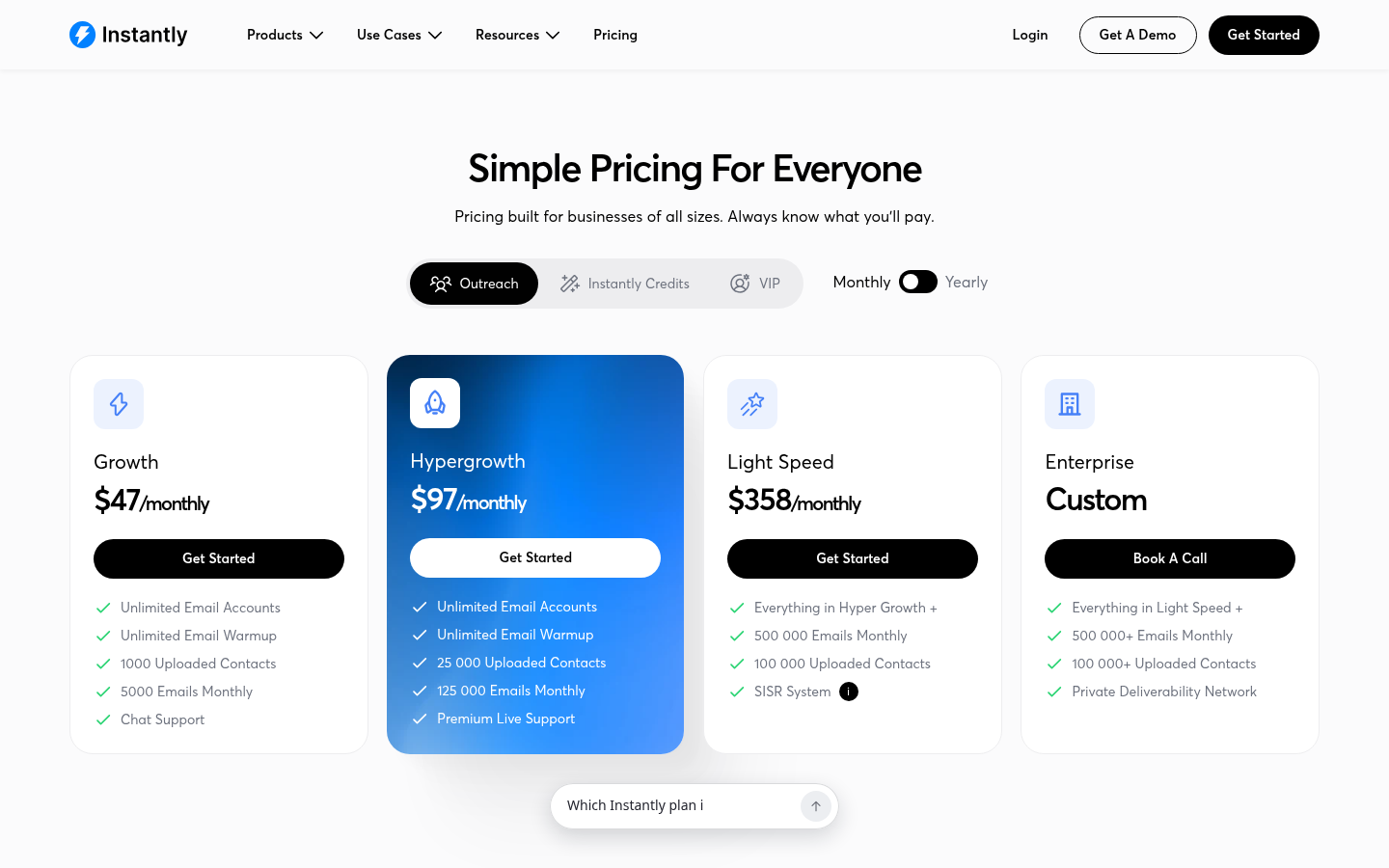
instantly.ai's pricing page, as of October 4, 2026.
Who it still fits: a team whose list sits comfortably under 1,000 or 25,000 contacts, wants the lead database in the same login, and sends on Instantly's shared infrastructure without worrying about it.
Smartlead
Smartlead's homepage positions it for "sales teams that run outbound at scale", and the product list reads that way: SmartInfra dedicated servers, Ultra Premium Warmup, SmartDelivery placement data, SmartDialer for calls, SmartProspect for leads, and a Unified Master Inbox.
The pricing page lists four plans on monthly billing. Base is $39 a month with 2,000 contacts and 6,000 email sends. Pro is $94 with 30,000 contacts and 90,000 sends. Smart is $174 with unlimited contacts and 150,000 sends. Prime is $379 with unlimited contacts, 500,000 sends and three SmartServers included. Annual billing takes 17% off: $32.50, $78.30, $144.50 and $314.60 a month. Verified prospect emails are a $59 a month add-on on Base (2,000 a month) and Pro (30,000), and come free on Smart (50,000) and Prime (170,000). CRM access is not on Base and is a $39 a month add-on on Pro and Smart. Warmup pool quality steps up by plan, from "Foundation tier" on Base to "Premium (eligible for Ultrapremium)" on Smart and Prime.
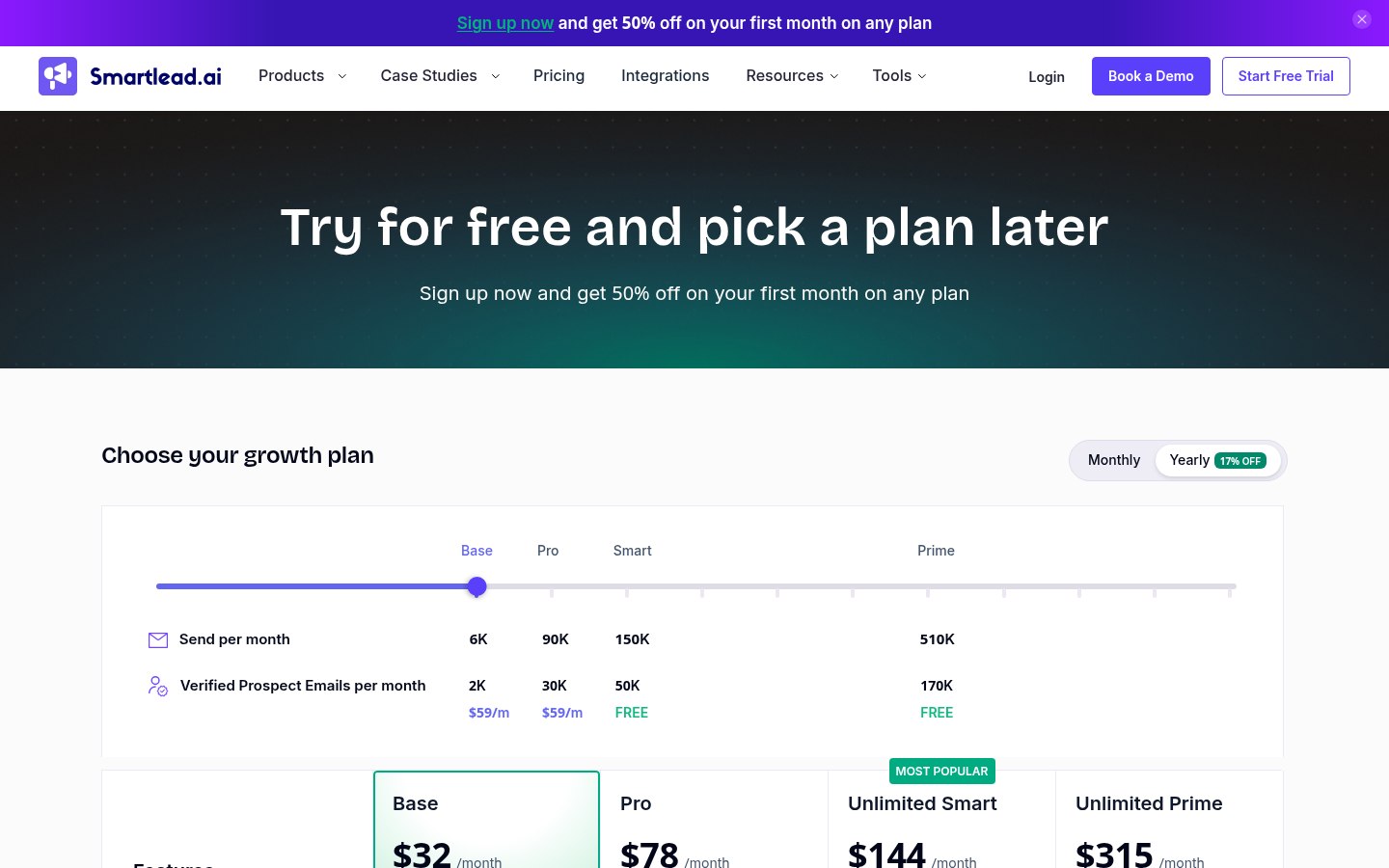
smartlead.ai's pricing page, as of October 4, 2026.
Add-ons are where the infrastructure lives. SmartSenders sells Google and Outlook mailboxes at $4.50 a mailbox a month plus $13 a domain a year through Zapmail, with pre-warmed mailboxes at $9. SmartServers are $39 a server a month for a dedicated IP. SmartDelivery placement tests start at $49 a month for 120 campaign sequence tests. The pricing page offers a free trial ("try for free and pick a plan later") and 50% off the first month.
On LinkedIn: Smartlead's sales automation page shows a SmartAgents template called Daily LinkedIn Lead Auto-Push, which pulls interested leads from Smartlead and pushes them into your LinkedIn outreach tool, Aimfox in one version of the template. That is the integration pattern the page describes: LinkedIn runs in a second tool fed by Smartlead's replies.
Who it fits: a founder who wants dedicated servers and placement data as line items they can switch on, and is happy to keep LinkedIn separate.
Lemlist
Lemlist's homepage calls itself "the only platform you need for outbound" and lists a 650M+ lead database, multichannel sequences across email, LinkedIn, calls, WhatsApp and SMS, a unified inbox, email infrastructure, and lemAgent AI agents.
The pricing page has two self-serve plans. Email is $69 a month on monthly billing, $55 on yearly, with unlimited users and email senders, 50,000 emails a month, the lead database, email finder and verifier, warm-up and deliverability hub, and CRM integrations. It is an email plan; LinkedIn steps are not on it. Multichannel is $109 a month per user on monthly billing, $87 on yearly, and adds LinkedIn automation, SMS automation, a built-in dialer and VoIP integrations, with five senders per user and unlimited emails and messages. Enterprise is custom. The comparison table lists unlimited contacts. Data add-ons start at $20 a month for 2,000 credits. The 14-day free trial includes the Multichannel plan's features except in-app calls, plus 200 credits.
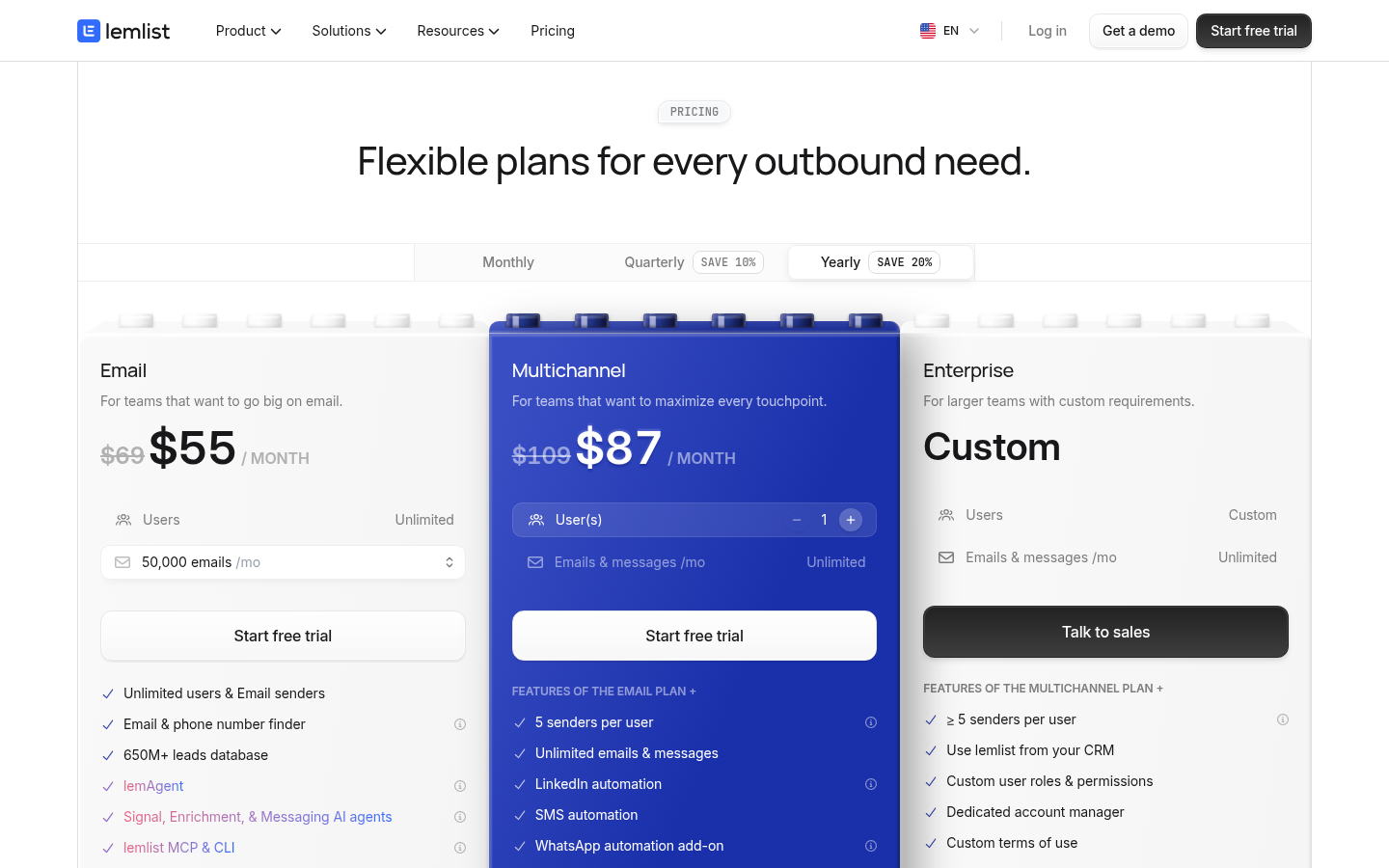
lemlist.com's pricing page, as of October 4, 2026.
The thing to notice is the unit. The Email plan prices on volume with unlimited users; the Multichannel plan prices per user. A solo founder pays one seat for LinkedIn. A team of four pays four. The deliverability list is long: in-app domain and email purchase, rotating IPs, DNS setup test, deliverability testing, inbox rotation and alerts.
Who it fits: a team that wants the widest channel list (SMS and WhatsApp included) and personalization features, and whose headcount is small enough that per-user Multichannel pricing stays sensible. If you are weighing it on cost, our comparison of Lemlist alternatives goes deeper on the per-seat question.
Woodpecker
Woodpecker's homepage promises "all you need for outbound in one place" and lists free email verification, free warm-up, inbox rotation, adaptive sending, a centralized inbox, domain audit and condition-based campaigns.
Pricing is built on contacted prospects, not emails or contacts stored. The pricing page explains the unit: contacting one person several times in one campaign counts once toward the monthly limit, and a campaign has up to 16 steps, so the page computes emails per month as contacted prospects times 16. The slider starts at 500 contacted prospects at $7.00 per 100, and the per-100 rate falls as you pick a higher tier. Annual billing saves 33%. The entry tier includes unlimited email verification, unlimited email accounts, unlimited team members, 100 Lead Finder credits and 2 free warm-ups, with more of the free extras unlocked at higher tiers. The page states a 14-day free trial.
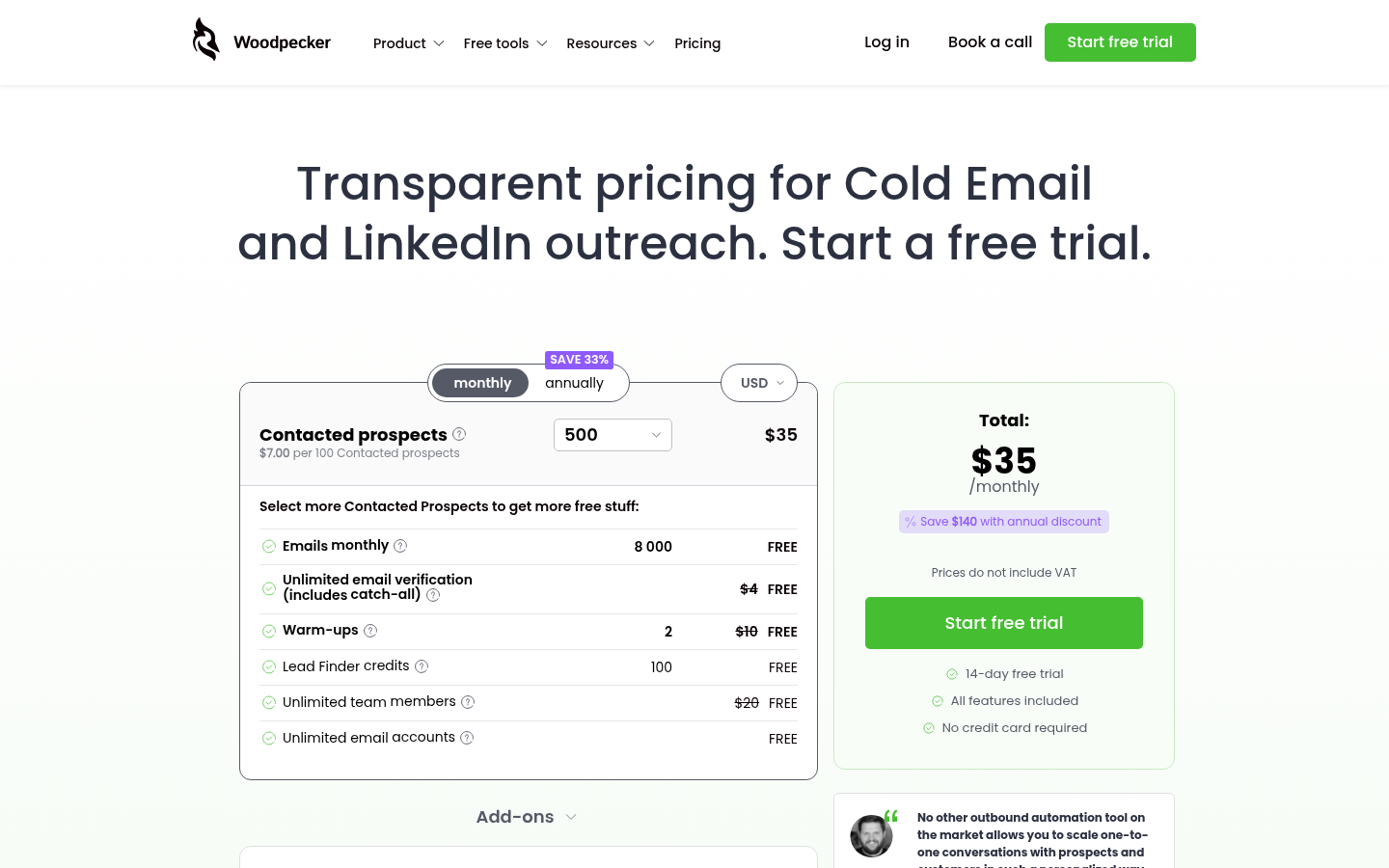
woodpecker.co's pricing page, as of October 4, 2026.
LinkedIn is an add-on at $29 a month per connected LinkedIn account. It is cloud-based, so invites, messages and profile visits run with your computer off, and the page says action counts stay inside LinkedIn's limits for free and paid accounts. Extra warm-ups are $5 a month per email account, and Google or Microsoft email addresses with SPF, DKIM and DMARC preconfigured are $6 a month each.
Who it fits: a small team that contacts a known number of people a month and prefers a bill that tracks prospects rather than a tier.
Mailshake
Mailshake's homepage leads with email automation that "lands in inboxes, gets replies, and books meetings", with Lead Catcher for engaged leads, a dialer, an AI email writer, Data Finder for prospect emails, and Social Automation for sending on social networks.
The pricing page lists three plans billed per user. Starter is $29 a month ($25 on yearly) with 1 email address per account, 1,500 sends a month, unlimited uploaded contacts, unlimited warmup, unlimited verification and A/B testing. Email Outreach is $49 ($45 yearly) with 2 email addresses, unlimited sends, email rotation, a unified inbox and CRM integrations. Sales Engagement is $99 ($85 yearly) with 10 email addresses, 5 phone numbers, a power dialer and unlimited dialer minutes to North American numbers. An Agency plan with unlimited email addresses is on request. Data Finder is a $19 a month add-on and Ready to Use Mailboxes are $12 a month.
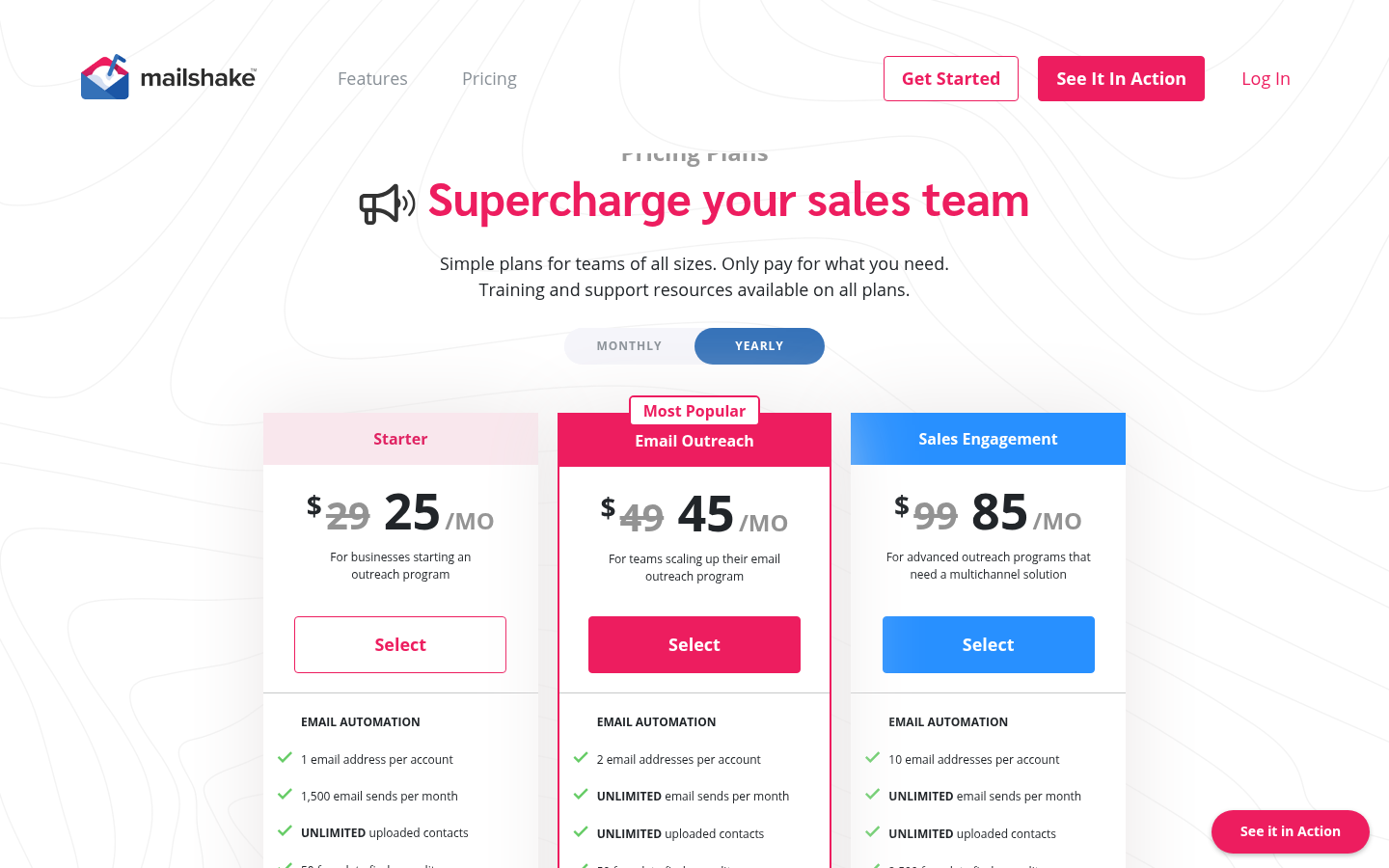
mailshake.com's pricing page, as of October 4, 2026.
Two FAQ answers on that page matter for a founder. There is no free trial; Mailshake collects payment up front and offers concierge onboarding instead. And each paid user can connect one mail account, so a solo founder who wants three sending inboxes buys three users.
Who it fits: someone sending a small volume from one or two inboxes, who values a simple interface and does not mind a per-mailbox bill.
Saleshandy
Saleshandy's homepage describes a multichannel outbound platform with a B2B database, email outreach, a dialer, WhatsApp and a task manager. Its pitch is built around setup time: buy domains, connect accounts, and have SPF, DKIM and DMARC configured in under ten minutes.
The pricing page lists three plans with no per-seat charge. Starter is $41 a month on monthly billing, $34 on annual, with 2,000 active prospects, 6,000 emails a month, unlimited email accounts, 1,500 lead finder credits a month and 1 user. Pro is $99 monthly, $76 annual, with 30,000 active prospects, 100,000 emails, 4,000 credits and 10 users. Scale is $189 monthly, $149 annual, with unlimited active prospects under a fair usage policy, 200,000 emails, 8,000 credits, unlimited users and personalized onboarding. Prospect storage is unlimited on all plans; the cap applies only to prospects in live sequences. Each plan has a 7-day free trial with no card required.
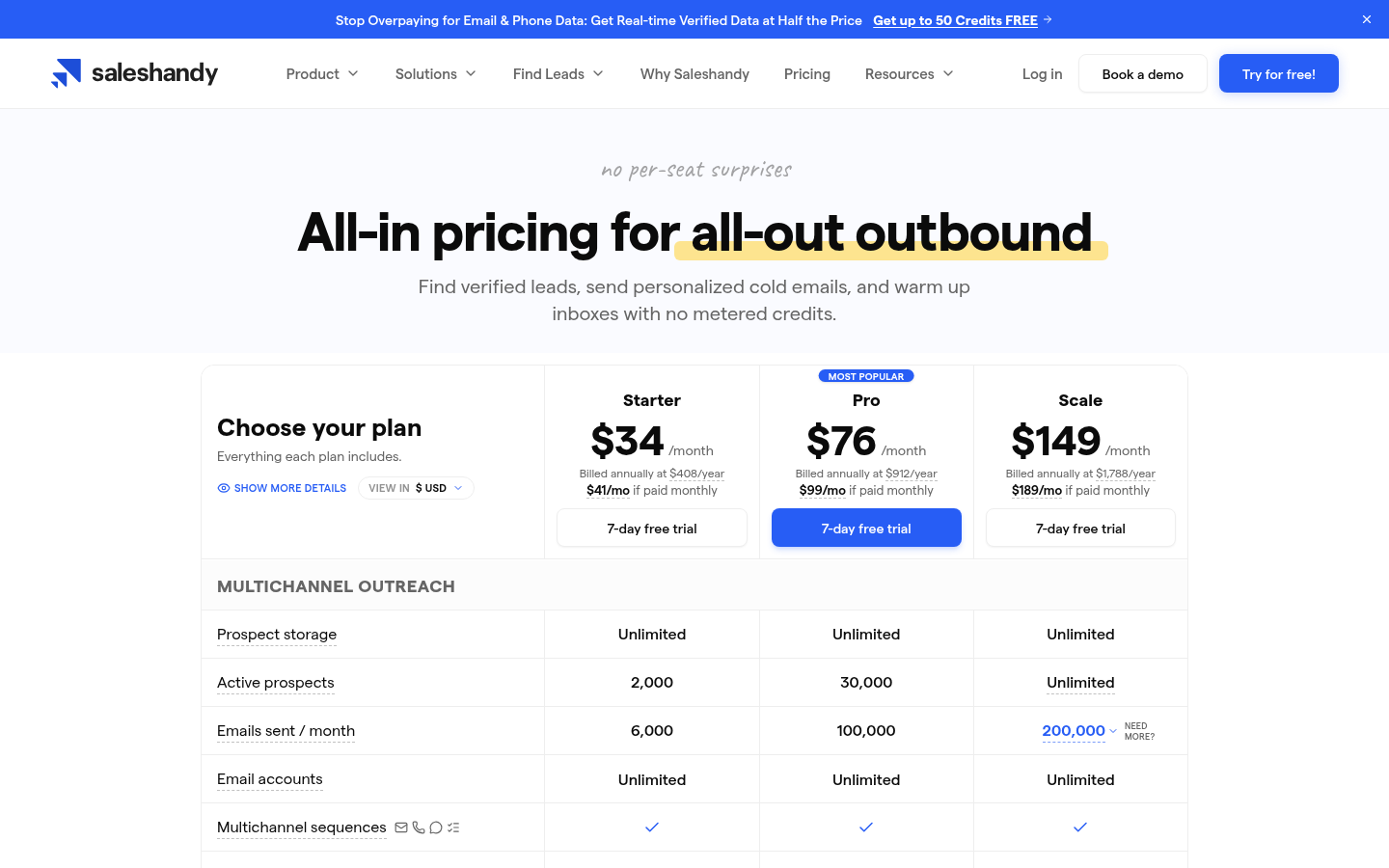
saleshandy.com's pricing page, as of October 4, 2026.
The multichannel sequences row says prospects can be reached across email, calls, LinkedIn and WhatsApp plus manual tasks assigned to SDRs, all in one sequence. The infrastructure add-on sells Google Workspace and Microsoft 365 mailboxes at $2.99 a mailbox a month on an annual fixed term, $3.49 annual flexi with free mailbox replacement, or $3.99 quarterly, each preconfigured and limited to five mailboxes a domain.
Who it fits: a team that wants a lead database and mailbox purchase under the same flat bill, and whose active list stays inside the tier.
SuperSend
SuperSend is built for the reader this page describes: a founder or a small team running cold email and LinkedIn themselves. Every plan includes every feature. The difference between plans is emails sent and LinkedIn senders, and contacts are unlimited on all of them.
Plans from $59 a month. Starter is $59 with 15,000 emails a month and 1 LinkedIn sender. Growth is $99 with 50,000 emails and 2 LinkedIn senders. Scale is $319 with 200,000 emails and 5 LinkedIn senders. Yearly billing saves about 15%: $600 a year ($50 a month), $1,008 a year ($84 a month) and $3,252 a year ($271 a month). Going over the monthly email limit is billed per email on monthly plans, at $0.006 on Starter, $0.004 on Growth and $0.0025 on Scale, so an unexpectedly good month costs cents rather than a tier jump. Extra LinkedIn senders are $29 a month. Google or Outlook inboxes bought inside SuperSend are $5 a month each and domains are $13 a year, with SPF, DKIM and DMARC set up on purchase. The full breakdown is on the SuperSend pricing page.
Email and LinkedIn steps sit in one sequence against one contact record, so a reply on either channel stops both. Our playbook on building a cold email and LinkedIn sequence shows how to order the steps.
Deliverability runs next to the campaign. Warmup runs on each mailbox, placement tests run against 10 seed inboxes by default, including Google and Outlook (5 credits a seed, 50 for a default test), email validation costs 1 credit an address, and a bounce guard pauses a campaign when its invalid-recipient bounce rate passes 3% after 100 sends, or after 10 invalid bounces on a small campaign. The default send cap is 15 emails a mailbox a day, adjustable per mailbox. The deliverability monitoring page covers what each check watches.
Replies land in one inbox, labeled by AI, with interested replies on top. Signup is free with no card. Launching a campaign or turning on warmup starts a 7-day trial with a card on file, charged on day 7 unless cancelled.
Not for agencies.
Which alternative to pick
Your list is bigger than your send volume. You have 5,000 contacts but send 10,000 emails a month. Instantly's Growth plan caps you at 1,000 contacts; Smartlead Base at 2,000; Saleshandy Starter at 2,000 active. Lemlist's Email plan, Mailshake and SuperSend put no cap on contacts. Of those three, only SuperSend runs LinkedIn in the sequence at that price: Lemlist's Email plan is email only and LinkedIn needs the Multichannel plan at $109 per user, and Mailshake caps Starter at 1,500 sends.
You want LinkedIn in the sequence and you are a team of one. Lemlist Multichannel at $109 a month for one user, Woodpecker's $29 a month LinkedIn add-on on top of a prospect tier, Saleshandy's one-sequence model, or SuperSend Starter at $59 with one LinkedIn sender. Check your own account against the daily limits first; our guide to LinkedIn automation limits lays them out.
You want dedicated infrastructure as a switch. Smartlead's SmartServers at $39 a server a month and SmartDelivery from $49 a month are the most granular on these pages. Instantly bundles its SISR system into Light Speed at $358 a month. If you would rather buy domains and mailboxes outside your sending tool, our comparison of cold email infrastructure providers lists each one's prices, minimums and send limits.
You want to buy inboxes where you send. Saleshandy from $2.99 a mailbox a month, Smartlead from $4.50 plus $13 a domain a year, SuperSend at $5 a mailbox and $13 a domain, Woodpecker at $6 an address, Mailshake at $12 a month. Whichever you pick, read our guide to setting up cold email domains and inboxes before you buy, because the number of domains matters more than the vendor.
You want the lead database in the same bill. Saleshandy includes lead finder credits on every plan. Instantly sells credits separately or in a bundle. Lemlist includes the database on the Email plan with paid data add-ons.
You want to try before a card. Saleshandy's 7-day trial needs no card, Instantly's pricing page says no credit card is required to start, Lemlist and Woodpecker list 14-day trials, SuperSend signup is free with a card required only when you launch, and Mailshake collects payment up front.
FAQ
Does Instantly have a free plan? Instantly's pricing page lists paid Outreach plans starting at $47 a month on monthly billing, with Bundles from $94, and says no credit card is required to start. Among the alternatives, Saleshandy's 7-day trial requires no card, Lemlist's 14-day trial includes the Multichannel features, Woodpecker offers a 14-day trial, and SuperSend lets you sign up free and asks for a card only when a campaign launches or warmup turns on.
Which Instantly alternative includes warmup in the price? All six. Instantly and Mailshake list unlimited warmup, and SuperSend includes warmup on every plan. Woodpecker includes 2 warm-ups on the entry tier and sells more at $5 a month each. Smartlead's warmup pool tier depends on plan. Lemlist includes its warm-up and deliverability hub on the Email plan.
Do I need a second tool for LinkedIn? It depends on the tool. Lemlist (Multichannel plan only, not the Email plan), Woodpecker (add-on per account), Saleshandy and SuperSend run LinkedIn steps inside the sequence, and Instantly's outreach page lists LinkedIn in its multichannel campaigns. Smartlead's own automation template hands interested leads to a separate LinkedIn tool. The practical question is what happens when someone replies on LinkedIn mid-sequence: in a single-sequence tool the email steps stop; across two tools you reconcile that yourself.
Why do the entry prices look so close? Because the entry plans cap different things. Instantly Growth and Saleshandy Starter cap contacts and emails. Mailshake Starter caps sends and mailboxes. Woodpecker caps contacted prospects. Lemlist Email caps emails only. Smartlead Base caps contacts and sends, with verified emails as a paid add-on. Price the plan against your own list size, monthly send volume and inbox count rather than the first number on the page.
What should I check before leaving Instantly? Export your contacts and reply history, and confirm who owns any domains or mailboxes you bought inside the platform, a point Mailforge's comparison raises as its "domain ownership" criterion. Then warm the inboxes in the new tool before you move volume, and move one campaign first rather than all of them.
Is shared infrastructure a problem for a small sender? Instantly's pricing page attaches dedicated server and IP blocks to its $358 Light Speed plan, and Smartlead sells dedicated SmartServers at $39 each, which tells you both vendors treat it as a scale feature. A founder sending a few hundred emails a day from properly authenticated inboxes is usually limited by list quality and send pace, not by IP, which is why placement testing and a bounce guard matter more at this size than a dedicated server.
Next step
If your list is bigger than your budget tier, run the numbers on contacts, monthly emails and LinkedIn senders against the table above, then try the tool that prices on the thing you actually use. For founders and small teams who want email and LinkedIn in one sequence with deliverability checks beside it, create a free SuperSend account. Signup needs no card, and the first campaign starts a 7-day trial.